
Home › Forums › SE England › Kent Mills A to F › Aylesford Paper Mills
Tagged: Case-making, Closed, MG machines, Newsprint
- This topic has 173 replies, 5 voices, and was last updated 1 year, 9 months ago by
Chris Bennett.
-
AuthorPosts
-
23rd December 2023 at 20:33 #1582
Artless Bodger
ParticipantOld MG cylinder ready to be lifted out, the MG press roll is visible underneath and on the left what appears to be the end of a vacuum box (2 handles on the end), and on the floor probably the press roll or vacuum couch roll. Fitters standing on the annexe roof behind with its fluted decoration along the top – I remember this from climbing up onto the annexe roof to clean the alum header tank during mill shuts (and finding the support ironwork corroded almost completely through by leaking alum).
Attachments:
23rd December 2023 at 20:35 #1584ParticipantCylinder now lifted clear of its bearings and hanging over the space formerly occupied by the reel up.
Attachments:
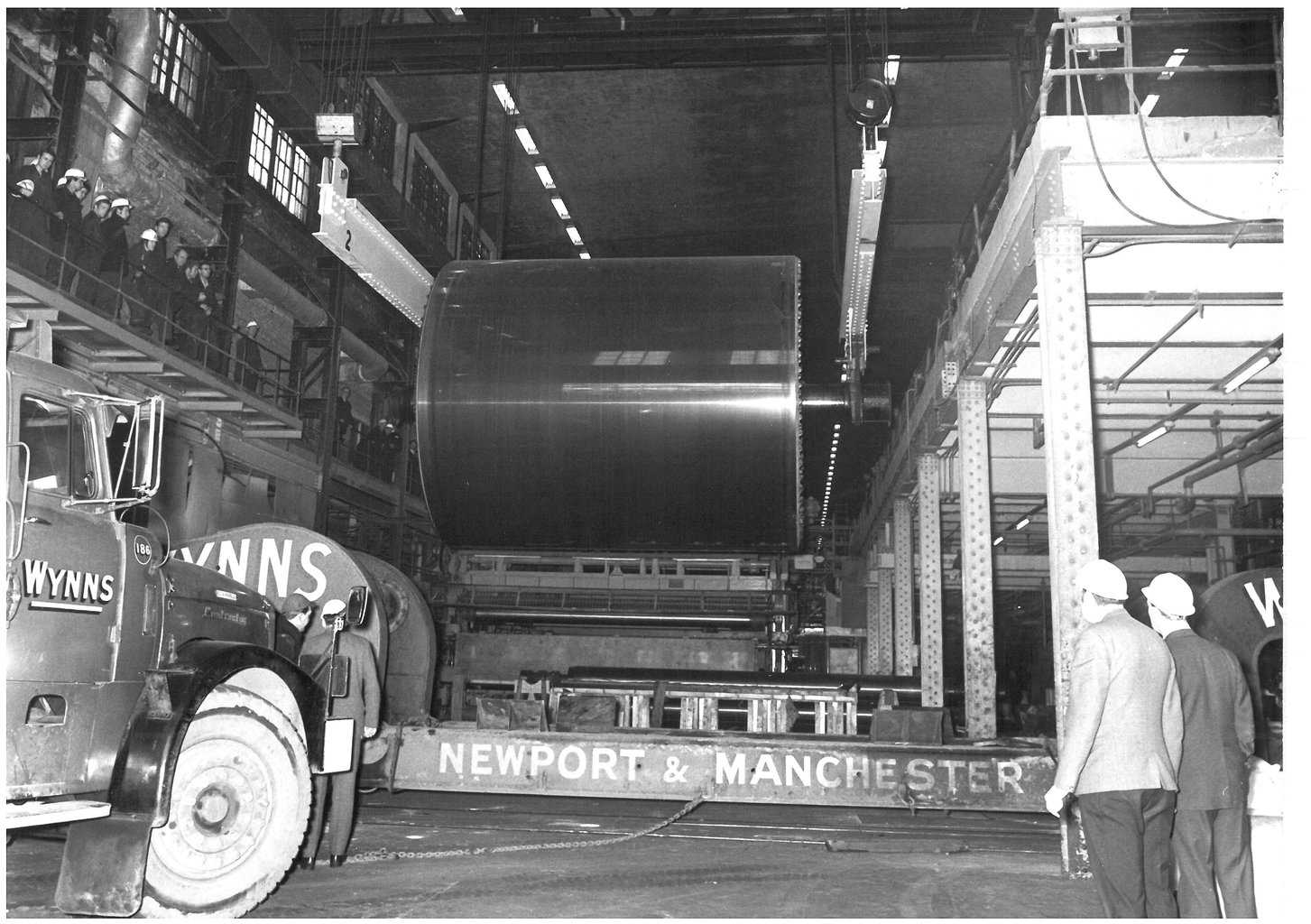
23rd December 2023 at 20:38 #1586ParticipantCylinder being moved down the machine house and positioned in front of n0 9 reeler ready to be lowered onto the Wynns Heavy Haulage low loader.
Attachments:
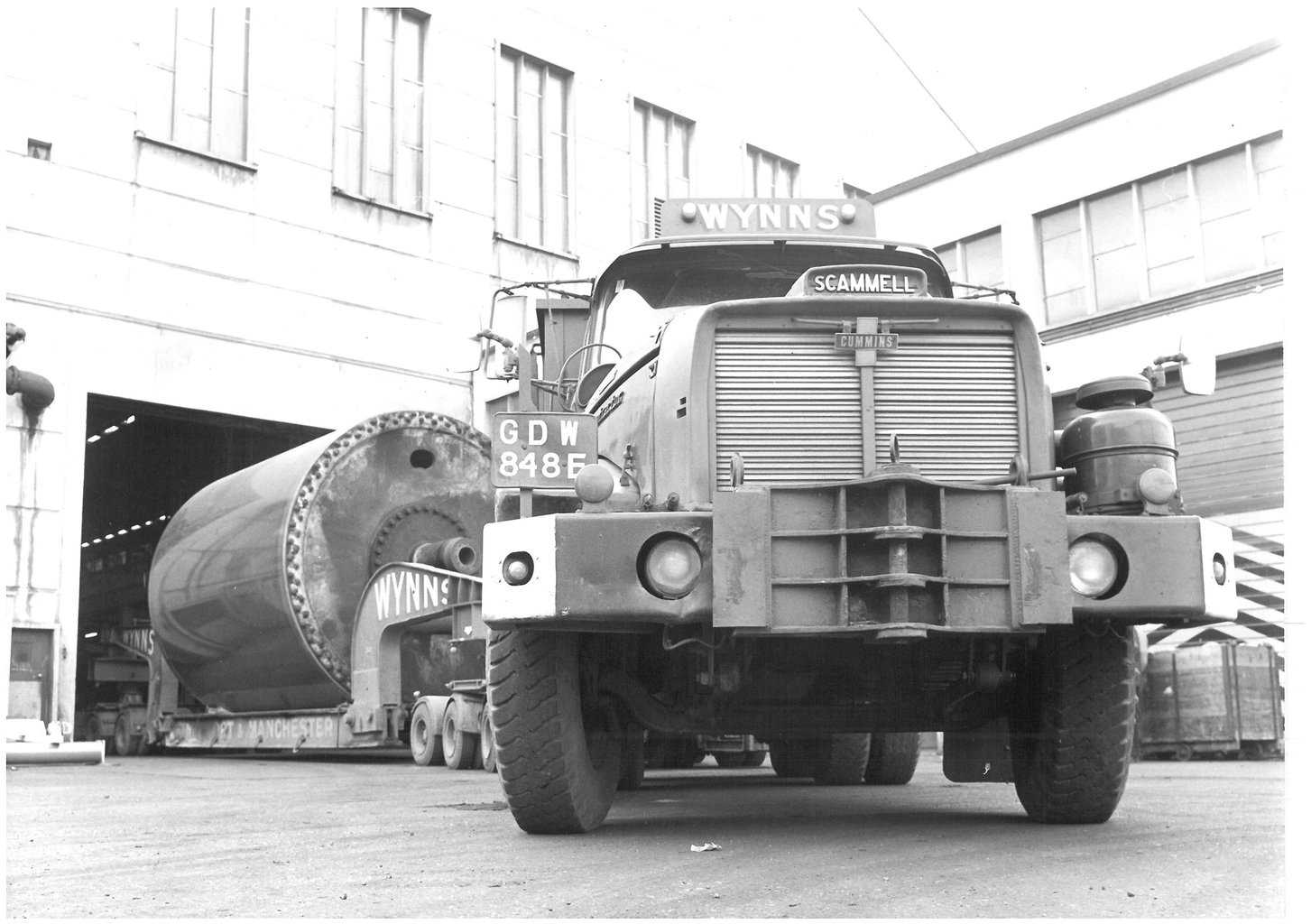
23rd December 2023 at 20:40 #1588ParticipantLeaving WM machine house.
Attachments:
1st July 2024 at 18:12 #1594Chris Bennett
KeymasterThe Wire Gang at Aylesford
I’ve been contacted with a question about the function of the wire gang. The questioner is a son of the one of the members in the 1970s.
The attached is a summary of the background and function of this group of men who performed the critical job of changing the heavy but fragile phosphor-bronze machine wires.
Attachments:
24th November 2024 at 19:35 #1616KeymasterRepost of article that I wrote a few years ago which seems to be lost.
I worked in Aylesford Mill from 1974 to 1981 – a period of change and contraction. However, despite ups and downs, it was very rewarding and stood me in great stead for my future.
Attachments:
15th December 2024 at 18:03 #1627KeymasterJohn Baker has sent me this information by email for inclusion in the Aylesford topic:
I started as a mechanical engineer apprentice in 1962 joining that year’s 1st year off the job training group. I was the only apprentice to complete my training in the newly built Reed Group R & D centre at the Aylesford station end of the site. It was there that I was most fortunate to work with scientists, doctors with a huge range of knowledge and skills backgrounds. Sadly, after I worked with various companies such as Reed Medway Sacks; Reed Polyfilms (the plastic bag unit of RMS); Reed Corrugated Cases; Kimberly-Clark; Key Terrain and all the paper mill departments, I was made redundant in 1972. This was especially sad for me as I was making full use of the wonderful sports facilities available on the site. I was very keen to get back working on the site again for this very reason and having kept in touch with people still on the site, I learnt of a vacancy for an R & D engineer with Key Terrain (later Reed Building Products). The position was to help set up and operate a small manufacturing workshop within the old Salle building. I was successful with my application. However, after being employed only a few months, my dream position in the Training School cropped up for an engineering training instructor. As luck would have it, this position was only advertised as an internal company application, so had I not been working on the site I would never have known about it. Having only been in my current position for a few months, it was extremely difficult and embarrassing to hand my notice in. Luckily, the head of my unit was somebody I worked with in the R & D unit, his name was Dr Don Broach. He was extremely understanding and allowed me to apply for such a position. I was very fortunate and started as an instructor in August 1973. In 1977, I became Senior Instructor and Head of Department and continued in this role until the College (now called Reed College) was transferred to SCA and then given away to Sheerness Steel in 1993. I felt after 20 years wonderful service in the College, it was time to move on.
It may not be common knowledge that the Reed Group extended the first year off the job training with the well-known Duke of Edinburgh Award Scheme, which entailed all the students being taken by the instructors to Derbyshire Peak District every year and spending a week under canvas. I was a Duke of Edinburgh Award Scheme company assessor for expedition work and would not have missed this experience for anything.
Many thanks, John. The College on the site was a valuable asset, training papermakers and engineers through the City & Guilds Qualifications and other skills including secretarial.
Some of the people involved in teaching in the college, in addition to John, were: Barry Watson who was Head of the Papermaking Training Department and papermaking lecturers Fred Blackmore and Ron Underdown.5th January 2025 at 18:25 #1640KeymasterAylesford Paper mill. No2 Machine. 1965-1971. “HAPPY DAYS”.

Posted on 5th January 2025 by Michael Presneill
My name is Michael Presneill, I worked on No2 machine from 1965 up to the point of the first redundancies, which I believe to be in 1971. My reason for wanting to post on this site is to give an account of how I remember No2 machine and the crew of people I worked with. If there are photographs out there of No2 machine, I really would like to see these and be able to put them into an e-file which others might view. If there are any of the crew out there I worked with during this period, I would like to make contact.
I was 18 years of age when I applied to Reeds for a job. The job description I was given was “Machine minder”. There were two of us being escorted from the offices to our place of work. That would be in No1 and No2 machine house.We had been brought through 3 and 4 machine house and out past the testing office on our left and out by the dry-end of No2 being on our right. The super calendar and reeler were to our left. On first entering the machine-house, I had a job to get my head around the scale of the building, paper machines and of course, the “Noise”. My first day at Reeds started when I was presented at the Wet-end of No2 machine to the shift machine man (Mr Hamilton, better known as Hammy). I was told (his mouth to my right ear), I was now the “Press-boy”.
First Job …
“Up that wooden ladder boy and onto the top of the first press and clear the Doctor Blade following a break in production which had resulted in an amount of wet-stock being left there. When you’ve done that, do the same for the second press”.
A bit of an eye-opener, but what the heck, the job looked interesting and Hamilton (Hammy) was forthcoming with how the Fourdrinier worked, explaining everything as it happened. How I enjoyed working with that man, amongst many other things, he taught me how to use a slide-rule when calculating speeds for the machine to be running at to achieve the paper weight required. The first time I was on a 6-2 shift, I was asked to go to the R&D centre for classroom training. One of these sessions was enough for me and I informed our shift foreman, Mr. Ernie Jones, if I had to attend any more of these I would leave the job. I told him, I had come to Reeds to work on a paper making machine, not in a classroom. I never went back to the classroom.!! My paper making experience was all practical and I loved every moment.
OK, a few names of people on No2 machine and on my shift. Machine-man “Hamilton”. Dryer-man “Frank Cornell, Maidstone”. 1st Assistant. “Alan Bannister, Rochester” (This guy and I were in the same class at secondary school). Shift Foreman, Ernie Jones. Day Foreman I think was a man named Crosier, possibly, wore a trilby hat, I think. Looking at that name now in 2024, that person could have been the Day Forman at Townsend Hook when I first left school and went to work in 1962 at the Townsend-Hook paper-mill in Snodland.
No1 Machine operatives, same shift, whom I remember. Machine man. I am unable to remember the gentleman’s surname, but do remember he was always referred to as “Dinner”. Press-boy was “Bootsie, Rochester”. Felt-boy was “Rod, Strood”. Drier-man “Ray Bowles West Malling”. 1st Assistant name “Malcolm”. During my time on No2, I only remember No1 running Kraft paper.. I do believe it sometimes runs a heavy gauge fluting. Nothing else.!!
Other shift operatives. No2 Super Calendar-man, “Bill Whibley” from Snodland. Overhead Crane driver, “Sid Auburn” from Rochester. There were more but do not remember their names. Sorry.!!
No2 Machine… While I was on the presses of No2, plastic foils were trialled, and later replaced the metal type. If memory serves me correct, a plastic wire was trialled and some time before the redundancies, these plastic wires replaced the phosphor bronze type.
After a couple of years, I was elevated to the lofty position of “Felt-boy on No2 machine”. My working position on the machine was seated (two wooden benches and a wooden table) between No1 and No2 machine, opposite the starch press. I had a companion. “Rod” Felt-boy for No1. Our job was to ensure the dry-felts remained square at all times. There were automatic felt adjusters for this, however, on the odd occasion these failed and the dry felt would creep across and turn over resulting in a shut-down to turn or replace the felt. I’ve seen the time when, if this happened and the sheet broke, it would end up wrapped around the outside of the felt tensioner roll but inside the felt itself. To resolve this, our drier-man Frank Cornell would roll his shirt sleeves down, tuck his trouser bottoms into his socks and tie both with string to prevent them from riding up. This done and with No2 shut down and the Stop-Lock put onto the Stop/Start Dryer section Starter Box, It was down to Frank holding a steel spike to crawl between the Hot felts to release the paper from the tensioner roll. In those days, Health and Safety wasn’t what it is today, but of course we were all very aware of the dangers working in this type of environment and so ensured we adhered to the safety protocols which were in place.
“Other duties” of a felt-boy as described by Shift Forman Ernie Jones.!! “Keep the machine-house floor clean at all times and ensure you keep those water and air hoses curled up neatly. Starch Press to be spotless at all times” Sounded simple.!! But Ernie was a stickler for cleanliness and he inspired me to keep No2 spick and span and ready for action what ever came along. Soon after becoming Felt-Boy and whilst on nights, Ernie asked me to go to the fitters shop and collect a bucket of paraffin and a large amount of cotton waste. When I returned to the machine house floor, I was asked to wash the frame of No2 with the paraffin and the cotton waste. After a couple of nights, “She (No2)” was green and clean (green being the frame colour) and shining. The bit was now between my teeth and following another trip to the fitters shop, I came back with a “Tin of Brasso”. Now I could polish The CYLINDER END CAPS.! WHICH WERE BRASSSSS.!!
MAD, I KNOW, BUT I JUST COULDN’T HELP MYSELF. Ernie appreciated my efforts and so did the rest of No2’s crew. No1’s crew thought I was mad.!!
No2 had a Starch press between the 1st and 2nd section drying cylinders. Hamilton my machine-man had taught me how the Wet-end worked and now Frank Cornell our Dryer-man set about teaching me how the starch-press worked and how to operate it. I now had a position at a light green control panel with switches, starch flow and a paper tensioner “The 2nd section cylinder Draw Switch”. I was in heaven.!!
During my 6 years on No2 machine, it produced high quality coated printing papers and on a couple of occasions they trialled running newsprint. On the 15th February 1971 which was Decimalization day, I was on a 6-2 shift and it was my job to go get 1 and 2’s breakfast order from the canteen so off I went with Wicker Basket slung over one arm, when I returned to the machines with the breakfast, I came back with more money than I started with. Happy Days.!! Decimalization and the job on No2 really did suite me.!! Sadly for me, it all came crashing down when the redundancy notices were later given out.
My brief encounter on No2 ended with the redundancies, however, later in life having gone into business in the road haulage Industry I had need to visit New Hythe and that resulted in me making one last trip up into No 1 and 2 machine house which was now silent. No1 had been dismantled and sold-on. No2 was silent, complete but not operational. The frame was still Green. The machine-house was cold and very uninviting, not like it was when I worked there, when it would be hot and humid. I briefly spoke to two guys who were standing in a sound-proof booth where the stack of shells for No1 used to stand, telling them how it was when I worked on No2. I slowly walked the length of No2, from the dry-end reel-up to the wet-end, recounting my time there as a young man, running up the steel ladder which took you up under the machine canopy to check on the felts and my first encounter with “Hammy”. I could see and hear the sounds of a time now passed. “HAPPY DAYS”….
Michael Presneill. Gillingham, Kent. – Mike can be contacted via the forum.
-
AuthorPosts




- You must be logged in to reply to this topic.