

Forum Replies Created
-
AuthorPosts
-
Chris Bennett
KeymasterThe involvement of SAPPI is mentioned in this post by Richard Moyle:
https://ukpapermills.org.uk/topic/wolvercote-paper-mill/#post-1077
KeymasterThe involvement of SAPPI is mentioned in this post by Richard Moyle:
https://ukpapermills.org.uk/topic/wolvercote-paper-mill/#post-1077
where Fife Mill is referred to as Transcript.
KeymasterIn 2017 there was an exhibition about Tullis Russell curated by Glenrothes & Area Heritage Centre
https://www.thecourier.co.uk/fp/business/business-news/430548/rise-fall-tullis-russell/
Unfortunately, although the Heritage Trust will continue their permanent display venue has closed in 2020.
https://www.facebook.com/glenrothesheritage/
KeymasterI replied to this question by email – here is the exchange in reverse order:-
14/09/2020 16:02
Thank you for this information. I’ll pass it on to my friend. I’m happy for you to share this on the ukpapermills forum with his name.
14 Sep 2020, at 15:45
I see from the 1939 register that Alfred was a beaterman, not as the transcript on Findmypast says Dealer man. It was his job to prepare the fibre for the paper machine, probably as a batch process at that time, so a skilled job. The career progress is indicated by his 17 old son being a Press-boy an entry level job but above the labourer.
Shows the home as belonging to Kent Kraft Mill.
Kent Kraft Mills LtdNorthfleet. ” T. N. Greenhithe 3122. Pure U. G. Kraft. Raw material, Sulphate Pulp. One Machine: 180 inches finished paper.
This was part of Robinsons of Bristol – see second link at:
https://ukpapermills.org.uk/topic/kent-kraft-paper-sack-mills-northfleet/
When the mill started in 1930 they were using new pulping technology so the beaterman would have been extremely important to the success of their enterprise.
Not sure if the Wiggins Teape link is there because Kent Kraft was not linked to them and The kind of paper made at Davidsons Aberdeen was closer to that at Kent Kraft. However, it is quite possible that he moved with WT and was then recruited for the new machine start-up.
14 September 2020 13:18
His name was Alfred McInnes born in Aberdeen in 1895 died 25 December 1939 in Gravesend Hospital after his car was involved in an accident with a bus. His home address was Papermill Cottages, Northfleet, Kent.Most of the men in this family worked at the papermills over the generations. I did think Wiggins Teape may be the connection & the family lived in Woodside, Aberdeen which is very close to Stoneywood & Bucksburn.
14 Sep 2020, at 11:25
That sounds interesting. By that period nearly all paper was made by machine but in many ways the labour structures were similar. It took many years for progression through the skill hierarchy to achieve the few well-paid positions of the most skilled. As promotion was often blocked people would change mill.
I have a 1923 directory that shows four mills in Aberdeen area:
Aberdeen Culter Co., Ltd. Culter Mills Paper Co., Ltd., Culter Works (9),Peterculter, Aberdeenshire (S).
N.R.S., Culter. T.A., ” Ninemill, Peterculter.” T.N., 1 Culter. Three machines, 96 ins. 72 ins. and 63 ins. E.S; and T.S. Writing and Envelope Papers, Printings and Plate Papers, Cartridges, Imitation Parchment, Opalines, Ivory Boards, White Pulp Boards. Tinted Papers, and Tinted Pulp Boards, Chromo and Art Papers of every description, Cloth lined Papers, Manilla Boards, etc.
Donside Paper Co., Ltd., Donside Paper MillsAberdeen (S).
N.R.S., Don Street. T.A., “Don, Aberdeen.” T.N., Woodside 765 (3 lines). Three machines, one 96 ins. and two 126 ins. News and Printings, 25,000 tons yearly.
Pirie (Alex.) & Sons, Ltd., Stoneywood Works (7),Bucksburn, Aberdeenshire (S).
N.R.S., Bankhead or Bucksburn, G.N.S.R. T.A., “Pirie, Aberdeen.” T.N., 21 Woodside. Six machines, 60 ins. to 96 ins. Fine and Superfine Writings, Bank and Typewriting, Book, Loan and Cheque Papers, Cartridges, Blottings, E.S. Writing and Envelope Papers, Pulp Boards, Papeteries, etc.
Davidson (C.) & Sons, Ltd., Mugiemoss and Bucksburn Mills, (Nos. 66 and 80)Bucks burn, Aberdeenshire (S).
N.R.S., Bucksburn, G.N.S. Railway. T.A., ” Paper, Aberdeen.” T.N., 34 Aberdeen. Three machines, two 63 ins. and one 108 ins. M.G. Caps, Krafts and Manillas, Browns, Greys, Sugar Papers, Imitation Parchment, Middles, Felt Papers, Roofing Felts. Also all qualities of Paper Bags, printed and unprinted. 7,000 tons annually.
Kent had about 20 mills in the directory. A quick look suggest that, if the person moved within a paper company to a mill in Kent the most likely would be Stoneywood as that was allied to the Wiggins Teape Group which had in Kent:
Wiggins, Teape & Co. (1919), Ltd. Buckland Mills (27),Dover (E)
N.R.S., Dover. T.A., ” Teape, Dover.” Machine-made T.S. Writings, Banks, Account Book and Envelope Papers, and Cartridges.
Later Wiggins Teape acquired Dartford Mill (despite having often visited this mill I have not been able to identify which of the 4 mills Dartford listed in 1923 is was)
and Chartham Mill:
Howard (W.) & Son, Ltd., Chartham Mills (33),
nr. Canterbury (E).
N.R.S., Chartham, S.E. & C.R. T.A., ” Howard, Chartham.” T.N., No. 3 Chartham. One machine, 69 ins. Animal Tubsized Air-dried Writings, and Account Book Papers, Drawings and Cartridges, Loans, Banks, and Typewriting Papers, Envelope Papers, Extra Superfine Pastings, Stamp and Special Exact Water-marked Paper, and Photographic Paper.
If you give me a name and a place of death, I could perhaps find something else.
Hope this helps.
13 September 2020 09:17
Thank you for this information. I’m researching a friend’s family tree & she couldn’t understand why her father was born in Kent. Her grandfather was a paper maker in Aberdeen & moved to Kent sometime between 1920-30. The grandfather died in a car crash in 1939 & the family moved back to Aberdeen. I was trying to see if the same company in Aberdeen had mills in Kent.
13 Sep 2020, at 09:05
I don’t know the period you are interested in or how much you know about paper making so it’s hard to know where to start. The industry was very economically unstable. Mills were influenced by raw material supply, water supply, markets, management efficency and especially fires so would expand and contract. The skilled workers would move with the work, both on the their own initiative and by being recruited away.
Both Aberdeen and Kent were prime paper-making areas and there was significant movement of labour between them.
There is a free novel by Eden Phillpotts (has been called Devon’s Thomas Hardy) at http://www.gutenberg.org/ebooks/55468, published 1919, set in early 20th century hand-made papermill in Devon. The story is rather dated but there is interesting paper-making insight within the story especially in the first part.
KeymasterBlackburn Library has a Community History Website Cottontown.org Specific history of Star Mill:
Star Mill backgroundAlso article on Star and other local mills by Mike Malley:
The BAPH collection of small scanned images. Supplied by Mike Malley.
A few others from other collections.
Rather clunky search facility, could not find a thumbnails page. The library would like any information on the pictures especially if any people can be identifed.
KeymasterImperial Mill ran fireless locomotives around the site. No boiler, therefore no fire, good safety route on a papermill site. Large tank for pressurised steam filled from mill steam supply.
There were at least 3 units. One now named Imperial No1 is at the Science Museum.
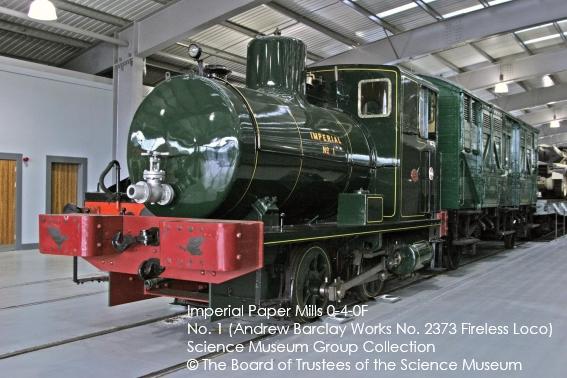
More information and pictures at Kent Rail
KeymasterWater Supply
Water for Forth / Kilbagie Mill was supplied from three boreholes and a small loch in the hills, one Km to the east of the mill.
The artificial loch, called Peppermill Dam, collected run-off from around 3 square Km but was mainly supplied by pumping from Longannet Coal Mine 2 Km to the south. The water from the mine and therefore the dam was very high in iron which was a problem in the mill, especially when they were making fine paper grades with OBA. Treatment of the inlet water was aluminium sulphate and polymer followed by settling.
In March 2002 a severe flooding occurred in the mine and shortly afterwards the mining company went into receivership cutting off any prospect of further water for the mill from that source. As part of the technical support being provided by Quasar Chemicals to the mill, a study of rainfall accumulation was made, with the conclusion that the deinking operation would need to be redesigned to work with the reduced water supply.
Leicester Paper Company shut the mill shortly afterwards.Attachments:
KeymasterAh I see.
I had never considered or even thought about the type of machines that No5 and No7 were. They were just gaps in the machine house.
I’ll change the document – thanks.
BTW I found the details about the place of No8 machine in the history of Kimberly Clark in the UK interesting. Part 2 at:
Keymaster1955 Times article on the REED Group
KeymasterHi Artless
Many thanks for the link.
There are a few video and picture references around the web that I have found. Have put into the two attached files.
Cheers
Chris
-
This reply was modified 6 years, 3 months ago by
Chris Bennett. Reason: Update of picture links doc
KeymasterHi Artful
Welcome to the forum – apologies for lack of organisation around Aylesford Topic. There is more at https://ukpapermills.org.uk/topic/aylesford-paper-mills/Looks like we may have worked there at the same time. I was there 1974-1980 – written up at APM Memories
We would be interested in your contributions.
I well remember the loco Hornblower and especially the chlorine plant that was in my department. The emergency plan, that included the evacuation of Maidstone, was the stuff of nightmares.
KeymasterHi Artless
Welcome to the forum
Different world when suppliers had budgets for constructive enterainment and mill people used the oportunities to learn and meet with others in the industry. Of course, we didn’t have the multiple channels of communication of knowledge and ideas exchange there is now.
Chris
Keymaster
John Roberts has supplied the equipment sale brochure made after the mill shut see attached file.
-
This reply was modified 6 years, 3 months ago by
Attachments:
KeymasterThanks for your contribution Barry.
It is interesting to see how attitudes are changing.
Suppliers to the paper-industry, more than most industries, were faced with many customers with a high sense of entitlement to “perks” – personal (copious lunches, freebies etc) and business (expectation of instant service and suppliers’ personnel doing jobs that the mill couldn’t be bothered with but were important for the operation).
Led to a blurring between perks and bribery which certainly was not healthy to the long-term industry.
The oil industry recognised this in the 1990s and were much stronger for it.
28th April 2020 at 10:35 in reply to: Sherborne Mill, Kings Norton, Baldwin (James) & Sons, Ltd., #992KeymasterSite in 2019 Courtesy Google Earth

Site in 1945 Courtesy Google Earth

-
AuthorPosts