

Forum Replies Created
-
AuthorPosts
-
Chris Bennett
KeymasterHi Skyline
As i sent in an email, I have not been able to find any reference to the building being occupied by a paper related business. I have checked Trade Directories etc.
If there is a connection it would probably be a converter- a company making boxes, bags or envelopes. It would need to be a long way back for them to be using canal transport.
I see there is a planning application in the area – presumably Skyline Industries are moving on?
KeymasterAlkaline Paper making
Kilbagie Mill (together with Wolvercote Mill) in the late 1970s and early 1980s was in the forefront of replacing rosin size with AKD alkaline size.
This paper A Review of Paper Quality and Paper Chemistry JC Williams
reflects the enthusiam of the Technical Manager, Hugh Bryson:
The major portion of the American paper industry has continued to make rosin-alum-sized acid impermanent paper. European paper- makers, however, have been more responsive. Gestetner Papers Ltd. in Scotland is producing excellent calcium carbonate filled papers. Hugh Bryson, Process and Technical Manager for Gestetner, has been helpful and generous in sharing his experiences:
The considerable upsurge in the last five years of non-rosin derivatives for neutral sizing of paper, coupled with the use of calcium carbonate fillers, has opened a new realm of papermaking. Neutral- sized, calcium-carbonate-loaded papers are now firmly established in the European market, not only, as was originally thought, for specialty lines, but competing successfully in the popular lines of lithography (stationery sizes as well as conventional litho sheets), industrial papers, chart papers, continuous stationery, archive text, photocopying, and coated stock (on machine-blade and off-machine coated). What has the technique of neutral, i.e., non alum-rosin sizing to offer? The answer is very simple, better paper at a lower cost.In a letter, Bryson added: FALL 1981 209
Economics-Brilliant!-and getting better each year as the cost of energy rises, that is in comparison with non-alkaline paper-making. At present, we see a 32% reduction in energy in comparison with acid paper-making. [There is] a reduction in the number of drying cylinders one would normally use for acid paper-making due to the ease of drying the increased carbonate filler one can more readily carry in an alkaline system. The reduction in oil, water and steam makes the picture an even greater financial success, and the big punch line [is] no capital investment to change to neutral sizing and carbonate filled papers. Specia1 equipment-Paper-making-w ise- none; laboratory-wise- nothing that is not normally found in progressive technical laboratories, whether they are acid or alkaline paper mills.
21 Samples of Gestetner paper have been given accelerated aging tests at the Library of Congress Preservation Research and Testing Laboratory and found to have an excellent life span.
It was not as simple as it sounds. Betz UK were the biocide suppliers and struggled to control the microbiology of the new system, despite biocides that were far more toxic than those available now. At one stage they resorted to Acrolein imported specifically from America. The literature often erroneously refers to alkaline mills having fungal problems. This was because, at Kilbagie, the suppliers wrongly identified Sphaerotilus natans as fungi.
KeymasterScotland’s Lost Industries By Michael Meighan Originally published: 2012
Displayed on Google Books by permission of Amberley Publishing Limited. Copyright.Kilbagie at Kincardine, also in Fife, is another paper mill that once was a distillery. Founded in 1720 by John Stein, Kilbagie was said to be the largest in Scotland at the time and produced until 1845. Kilbagie was famous as the site of the first continuous still, invented in 1826 by Robert Stein. It went bankrupt, said to be because of excessive customs dues.
After some time as a fertilizer factory, James Weir started the production of esparto-based fine papers in 1875, on machines supplied tothe mill by Bertrams of Sciennes, a 92-inch machine being the largest in the country at the time. In 1941, there were four machines at Kilbagie and they were also producing newsprint.
Gestetner had been a customer and eventually bought the mill in 1965 and then modernised it. Ownership changed to an Australian firm, the Pratt Group of Melbourne, before being taken over by Inveresk in 1995, to produce fine papers.
One commentator has described Inveresk as the undertaker of the Scottish paper industry. Having taken over a number of companies, it shut down mills in Musselburgh; Carrongrove in Denny; Caldwell’s in Inverkeithing; Westfield in Torphichen; and Kilbagie. Inveresk closed Kilbagie in 2001. The plant is now partly a waste management site.Additional information:
Post 2001 the mill was purchased by LPC (Leicester Paper Company) to use the deinking plant to produce wet-lap pulp for their tissue mill in England.
There was a serious mis-match in the type of “deinking” needed. The Inveresk focus was brightness while keeping the filler to improve the yield while for tissue the need was primarily for low ash.
Additional problems were water shortage, see below, and difficulties meeting the environmental requirements of IPPC.
LPC eventually shut their operation in 2005.
Keymaster Obituary of the first Manager of the mill George Hitchen d 1916.
World Paper Trade Review Vol 65 p22 23 June 1916 via Google Books
-
This reply was modified 6 years, 11 months ago by
Chris Bennett.
KeymasterObituary George Hitchen d 1916 Manager at the mill, when it was Wall-Paper Manufactureres Ltd and also started the Ingress Abbey Mill Greenhithe.
KeymasterPhoto from Timepix UK – thanks to Elaine Owen
KeymasterPhoto from Timepix UK – thanks to Elaine Owen
 Keymaster
Photo from Timepix UK – thanks to Elaine Owen
 Keymaster
Photo from Timepix UK there are probably others of mill that are not yet identified.
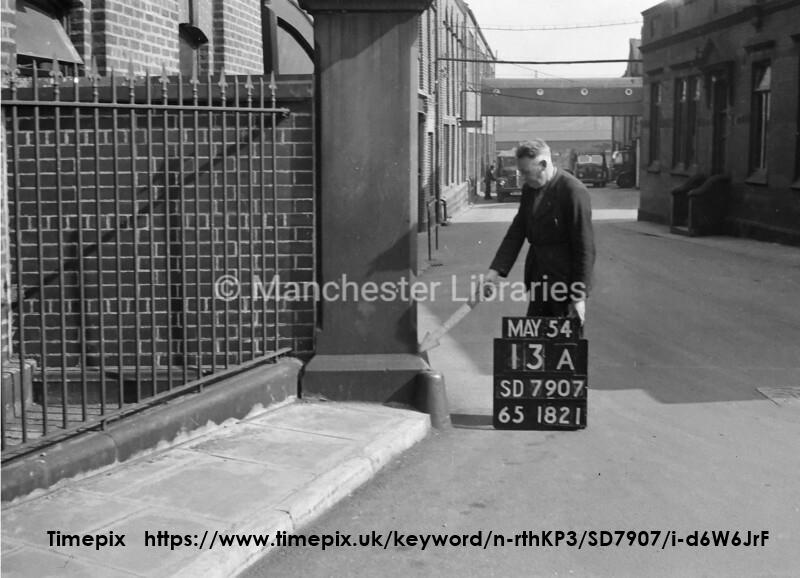 Keymaster
Photos from Timepix UK – thanks to Elaine Owen
 Keymaster
BAPH Qtrly 93 p26
Photos by Malcolm Austin of in the paper mill on the day that it shut:
 Keymaster
Pick of the Past 7th April 2016
From the Craven Herald archives
10 Years Ago
Thirty-four jobs hung in the balance at Langcliffe following news that the paper mill could close. John Roberts Holdings Ltd, which owned the former corn mill and cotton spinning mill, announced the possibility of the redundancies, blaming significantly rising energy and other costs. A spokesman for the company said in a statement: “After careful consideration of the trading pressures facing paper manufacturing, John Roberts Holdings Ltd has reluctantly decided to consider the possibility of closing its Langcliffe Paper Mill. There is little sign of trading conditions in paper manufacture improving.”
KeymasterHi
Not sure if you are refering to the correct mill here. Devon Valley is north of Exeter and is still running, Ivybridge Stowford Mill (Ivybridge) was north of Plymouth.I have put some information about the link between Ivybridge Mill in the UK and Ivy Mill in Pennsyvania on that forum branch.
Ivybridge Heritage & Archives Group have the mill archives of that mill. There people I can contact within BAPH to see if there are similar archive for Devon Valley.
KeymasterForum contributor imag.ivy at gmail.com has pointed out
Ivybridge Heritage & Archives Group has undertaken detailed research of the history of the Mill and holds the full mill archives collection donated to Ivybridge Town Council in December 2013.
Their website is listed above.
KeymasterIn answer to a question about possible link between Ivybridge and Ivy Mill Pennsylvania –
Papermaking: The History and Technique of an Ancient Craft By Dard Hunter p275 has:
In the year 1729 Thomas Willcox set up the third paper mill in the colony of Pennsylvania. This establishment used as a standard watermark a dove and olive-branch design with the initials of the papermaker — first TMW for the founder, and in later years MW, the initials of Mark Willcox, the son, who was operating the mill in 1767.
In 1827 an ivy leaf was adopted as a watermark, the mill being known as Ivy Mills on account of the English ivy that covered the stone buildings. The original vine was brought from England by Thomas Willcox to Pennsylvania in 1725, from near the Old Ivy Bridge in Devonshire.This book is available on Google Books along with other excellent books by Dard: https://books.google.co.uk/books?id=1sEp3rtK994C
-
This reply was modified 6 years, 11 months ago by
-
AuthorPosts