Home › Forums › SE England › Kent Mills A to F › Aylesford Paper Mills › Reply To: Aylesford Paper Mills
 Artless Bodger
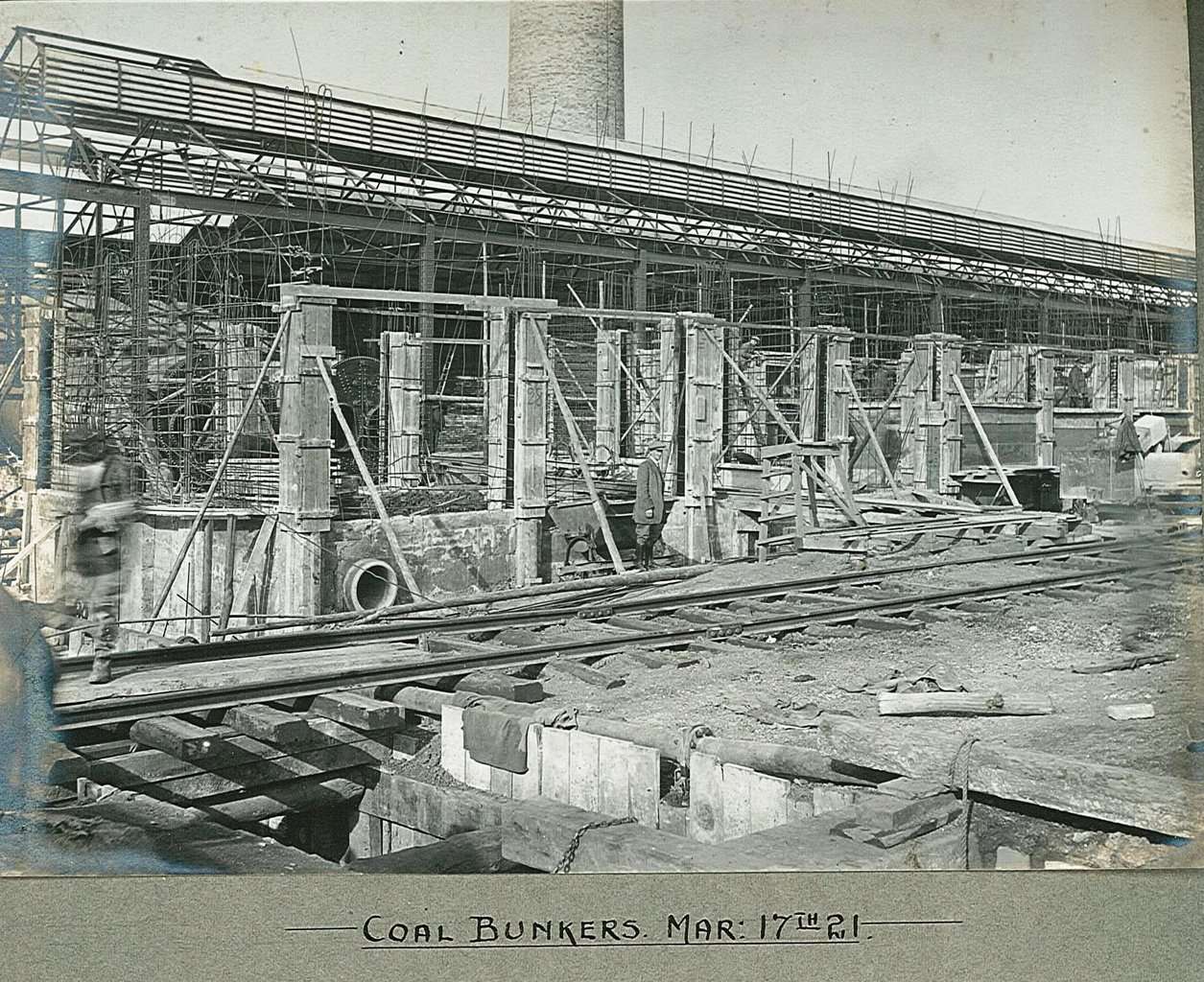
46. Coal bunkers under construction.
Lots of interest here and some questions arise.
Standard gauge track across the foreground – were the Lancashire boilers brought in along this siding? Two are visible in situ in the boiler house to the left. These are big and presumably fairly heavy items but the access to the boiler beds seems quite restricted in these photos, as the re is already corrugated sheeting on the north end wall, beaterfloor construction going on at the south end and the bunkers along the river front (in case they were delivered by water).
As an aside, we used to have photographs in the family (now lost) of the delivery of a new Lancashire boiler to Allnutt’s lower Tovil mill. This was delivered by rail (the loco was numbered in the later SR scheme with 1000 added to the original SECR number, so post 1927 or thereabouts), the boiler was brought into Tovil goods yard (on the goods branch), rolled off the wagon and down the embankment before being dragged up onto a solid wheeled trailer and towed around to the mill entrance by a traction engine. From there it was probably moved into position by packing and jacking and use of rollers. So the APM boilers could have been moved in a similar fashion. The NG track might just have been able to carry one on several wagons, but would have been a bit precarious, though precarious sums up quite a lot of the scenes in these photos.
The deep excavation in the foreground may just (almost certainly, see drawing AX130) be part of the excavation for the turbine condenser cooling water intake / outfall which extended under the river bed (see sketch), which I have seem drawings of. At this time the river bank extended beyond the new wharf wall, and was later cut back extensively, hence most of the excavation and pipe installation could have been achieved on ‘dry land’ (given the waterlogged gravel under the site as a whole). The pipe under the railway track is either temporary for dewatering the diggings (seen earlier), or permanent for the wet pit sump, as there appears to be a valve installed in the line further back.
There is a derailed NG skip wagon behind the gaffer, to his right a short NG spur served at right angles from the line across the bunkers (on which a skip wagon chassis stands), by a turnplate.