
Home › Forums › SE England › Kent Mills G to N › Imperial Paper Mills (Gravesend)
Tagged: Imperial mill, Railway
- This topic has 4 replies, 2 voices, and was last updated 6 years, 2 months ago by
Artless Bodger.
-
AuthorPosts
-
4th August 2016 at 14:10 #304
Chris Bennett
KeymasterMill Imperial Paper Mills Address Clifton Marine Parade , Gravesend, Kent, Nat Grid Location TQ638742 Companies Amalgamated Press; A. E. Reed; Reed International English Mill Excise No ND Status Shut during 1970 to 2015 Est. Papermaking Start Date 1912 Date Closed 1978 Links Link1 http://kentrail.org.uk/imperial_paper_mills.htm Link2 http://www.discovergravesham.co.uk/business-industry/paper-industry.html Link3 http://kenttodayandyesterday.blogspot.co.uk/2010/01/viscount-northcliffe-1865-1922-pioneer.html Britain from Above http://www.britainfromabove.org.uk/image/eaw042095 22nd March 2017 at 10:09 #670KeymasterFrom http://kenttodayandyesterday.blogspot.co.uk/2010/01/viscount-northcliffe-1865-1922-pioneer.html
Anonymous17 November 2011 at 14:50
I used to work in the building to the right of the White House which was the paper mills Lab. on the top floor, we also had a small store on the top floor of the White House. I used to collect samples around the mill paper and chemicals to test,also pulp samples off the ships before they were unloaded. There were 4 of us working there.in 1956. Martin.
Anonymous3 March 2014 at 15:37
In the mid 50’s I worked for the M.D. of Imperial P.M. in New Bridge St., London. We had a chair no-one ever sat in, that had been Lord Northcliffe’s. One of the main newsprint sources was the region behind Clarke City, Canada, on the St.Lawrence. I worked for the Managing Director of Imperial, and spent one whole day being shown around the works at Gravesend. Amazing place – so many really skilled workers. The noise of the rollers. Have never forgotten it. In my time at Imperial I learned quite a lot about papermaking and woodpulp.13th July 2017 at 08:37 #745KeymasterWISEArchive
Working Lives of Older PeopleMy Working Life 1960 – 2008 Anonymous
http://www.wisearchive.co.uk/story/my-working-life-1960-2008/
The outcome was that in August 1968 I resigned and started work for Imperial Paper Mills, Gravesend who were part of Reed International, my title had gone from Accounts Clerk to Clerk but my income had increased from £600 a year to £750. I now worked in a purpose built office, called “The White House” with Central Heating and Open Plan Offices. I started work helping to calculate and produce reports on the efficiency of the paper making machines. There were six machines producing some 3 to 4000 tonnes of paper a week and about 1200 employees. Each type of paper for each machine had a set of standards that the actual production was measured against. The main calculations were done by comptometer operators on mechanical calculators, these were made by a company called Diehl and were about the size of a typewriter, which made quite a noise as the cogs and wheels turned as the calculations were being done. Whilst the main calculations were done manually there were investigations done into why variances had occurred so I now moved into another field of expertise that I once again found out that I was quite good at. So much so that after I had been there for five weeks the Section Leader was moved to the Wages Department and I was given his job. This meant I now had to have weekly meetings with the Production Manager and Machine Superintendents to discuss the previous weeks inefficiencies. This was quite daunting as being relatively young, I was 24 by now and without any experience of dealing with management I was thrown in at the deep end.
I coped with this OK and earned the respect of those people that I dealt with and after a few years was again promoted, this time to Cost Clerk, I was now to be the assistant to the Cost Accountant. During this period Electronic calculators arrived, costing some £300 to £400 each and being about 20 cms wide, 30 cms long and 15 cms high, they were fantastic, instantaneous answers to the most complicated calculations. The equivalent today can be bought in a ˜Pound Shop” no bigger than 5 cms wide, 10cms long and less than 1cm high. We were now able to do all our own calculations but this meant that unfortunately the comptometer operators were redundant.
Several people had been in the position of Cost Clerk since I had been at the mill but none stayed for long so when I was offered the job in 1973 I had some doubt as to whether I should take it or not, especially as I had no experience, but with assurances from the management that I would be able to return to my old job if it didn’t work out I accepted after all promotion meant more money. I soon started to pick up the ˜Standard Costing System”, all costs had a standard against which they were measured and the Managers taken to task over any adverse variances.. The Cost Accounts were produced monthly to a deadline so a few late nights were now being experienced, no extra pay or time off in lieu but again more respect from the Chief Accountant for the effort I was putting in.
The mill had been in decline since about 1972 when the first round of redundancies were made and this had continued on various occasions until 1977 when much to my surprise the Cost Accountant was made redundant I was given his job but as I wasn’t qualified and Reed International didn’t allow any body without any qualifications to have Accountant as part of their job title I was to be the Cost Office Supervisor.
I had been in the job for about two years and we had a new Chief Accountant, from outside Reeds, who had seen what I was doing and unbeknown to me had fought for me to be given the title Cost Accountant, he won and I therefore became the only Accountant within Reed International to have Accountant in my job title, something that I was rightfully proud of.
Further redundancies followed until the mill was finally shut down in 1981, by this time I was earning £14,000 a year. The straw that finally broke the camels back and forced the shut down was Margaret Thatcher’s Conservative Party policy of not subsidising British Industry. At this time there were imports from countries who were being subsidised by their governments and able to undercut UK manufacturers prices. Peru was one of these countries.
A skeleton staff was kept on to oversee the sale of machinery etc. which was myself, a storekeeper, two engineers, an electrician, the purchasing officer and two security staff. It soon became obvious that I didn’t have enough work to occupy my time so I started having tea breaks with the others, I had never previously had a tea break in my working life, always drinking it at my desk whilst working. From this I started doing jobs with them to pass the time, during the eighteen months that I was there after the shut down I learnt welding, fork lift truck driving, plumbing and some electrical work. Oh yes I almost forgot, how to mark white lines on a warehouse floor we let out to a publisher and they wanted bays marking out.
Author moved on to Empire Mill.
8th July 2020 at 17:46 #1052KeymasterImperial Mill ran fireless locomotives around the site. No boiler, therefore no fire, good safety route on a papermill site. Large tank for pressurised steam filled from mill steam supply.
There were at least 3 units. One now named Imperial No1 is at the Science Museum.
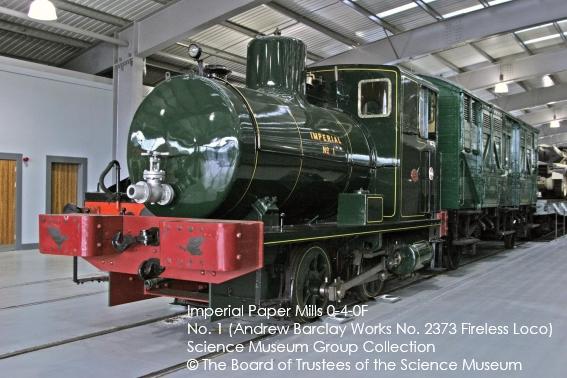
More information and pictures at Kent Rail
8th July 2020 at 23:28 #1056Artless Bodger
ParticipantI think this loco was saved by a local school boy who donated it to the NRM, there was a newspaper story about it. It would have been worth less as scrap than a conventional steam engine as it had no copper firebox or boiler tubes. Strange that APM didn’t use fireless locos. More photos of Imperial’s railway are to be found on Flickr.
I visited Imperial with Jim Martin and the EM mechanical engineer (unfortunately I cannot remember his name) after the mill had closed, looking to see if anything was worth salvaging, but most had already been taken out. I think Imperial no 7 was a twin to APM no 13 and there were rumours no 7 would be rebuilt alongside no 13, as the m/c house seemed to be designed for a second machine (though the control room etc, reeler and supercalender would need to be resited. The corrugated end wall always seemed a bit temporary.
-
AuthorPosts
- You must be logged in to reply to this topic.